
CD Duplication Near Me
Find Fast CD Duplication Near Me
Looking for reliable CD duplication near me? The easiest place to start is right on your phone or computer. A quick search on Google Maps will show you the local print shops and media services in your area. From there, you can jump into their customer reviews to see what people are saying.
This straightforward approach helps you find a trusted local partner fast, letting you skip the shipping hassles and get real, personal service for your project.
How to Find the Best Local CD Duplication
Finding the right local duplicator shouldn’t feel like a shot in the dark. You’re looking for that sweet spot: great quality, fast service, and a price that fits your budget. Going local gives you a huge advantage, especially when you’re on a tight deadline.
Think about it—you can drop off your master files in person and pick up the finished CDs yourself. This completely cuts out the risk of shipping delays and damage. Plus, you save on those extra costs.
That hands-on approach makes communication a breeze. You get to discuss your project face-to-face, hold a physical proof in your hands, and make sure every detail is perfect before the full run.
Vetting Your Local Options
Once you’ve got a shortlist of nearby shops, it’s time to do a little homework. Dive into online reviews on sites like Google or Yelp. Pay close attention to what people say about print quality, customer service, and how long it took to get their order. A couple of grumpy reviews isn’t a deal-breaker, but if you see a pattern of missed deadlines or bad communication, that’s a major red flag.
Next, just pick up the phone. A quick call is the best way to get a feel for a company before you commit to anything.
When you call, have a few questions ready. Ask about their minimum order size, what a typical turnaround looks like for a project like yours, and what file formats they need for your audio and artwork. This first chat tells you a lot about how professional and experienced they really are.
A good provider will walk you through their process without any hesitation. They should be able to give you a clear quote and explain anything that might change the final cost or timeline.
Key Factors for Choosing Local CD Duplication
To help you compare your options, this table breaks down the most important things to look for. Use it to weigh the pros and cons of each local CD duplication service and find the perfect partner for your project.
| Factor | What to Look For | Why It Matters |
|---|---|---|
| Turnaround Time | Clear estimates for standard and rush orders. | Ensures you can meet your project deadlines without unexpected delays. |
| Pricing Structure | Transparent per-disc pricing and bulk discounts. | Helps you manage your budget and avoid hidden fees. |
| Customer Reviews | Consistent positive feedback on quality and service. | Provides social proof of reliability and customer satisfaction. |
| Print Quality | Examples of their printing options (inkjet, thermal). | Guarantees your final product will look professional and match your brand. |
Ultimately, choosing a local partner is about more than just convenience. It’s about building a relationship with a company that understands your vision and is invested in helping you create a final product you can be proud of.
Understanding Your Duplication Options
When you start searching for “CD duplication near me,” you’re really looking at two very different ways to get your discs made. Knowing the difference between them is the key to making sure your project comes out right—on time, on budget, and looking professional. The two roads you can go down are duplication and replication.
Think of duplication as being like a high-end office copy machine. You’ve got your master disc, and the duplicator “burns” copies one by one using lasers to write your data onto blank CD-Rs. It’s the perfect solution for smaller batches, usually anything under 500 copies, because it’s quick and doesn’t have a massive setup process.
Replication, on the other hand, is the full-blown factory method. It’s like firing up a massive industrial printing press. The process starts by creating a “glass master,” which is essentially a perfect physical mold of your data. This mold is then used to stamp thousands of identical discs out of molten polycarbonate.
This is the exact process used for major label album releases you’d find in a record store. The initial setup takes more time and money, but once it’s running, the cost per disc plummets. This makes it the only smart financial choice for big orders of 500 or more.
Choosing the Right Path
So, which one is for you? The choice you make here really shapes the outcome of your project. Duplication gives you speed and flexibility for small runs, while replication offers a much lower per-unit cost when you’re going big. This is one of the first things you should talk about with any duplication service.
Here’s a look at the kind of duplication tower that local shops use to burn smaller batches of CDs.

This kind of gear lets a service burn several copies at the same time, which is why you can get such a fast turnaround on smaller orders. And don’t let anyone tell you physical media is dead—the global market for duplicated discs is projected to hit USD 4.6 billion by 2035, thanks to steady demand from both businesses and the entertainment world.
To break it down, here’s when you’d choose one over the other:
- CD Duplication: The go-to for anything under 500 copies. It’s fast (think 1-3 days) and perfect for demos, short-run band EPs, or corporate training materials.
- CD Replication: The only way to go for orders over 500 copies. You get the lowest possible price per disc, making it ideal for commercial album releases.
At the end of the day, the best move is to have a quick chat with a local expert about your project size and when you need it. They’ll point you to the most efficient and wallet-friendly method.
The Local Duplication Workflow Explained
So, you’ve handed over your master disc and artwork files. What happens next? A local duplication shop runs a pretty tight ship, designed for both speed and quality. Forget a massive, faceless factory line; think more of a professional kitchen where every single step is handled with care before your finished project is ready.
The very first thing they’ll do is a crucial file verification. This is their chance to play quality control, checking your audio or data for any glitches, making sure the tracks are in the right order, and confirming your artwork is formatted correctly for printing. It’s a simple but vital step that prevents a small mistake from ruining your entire run.
Once your files get the all-clear, it’s on to the main event: production. For most orders, your project gets loaded into a duplication tower. Picture this as a pro-grade multi-disc burner that can crank out several perfect copies at once—way faster and more reliably than your home computer ever could.
From Burning to Packaging
But getting the data onto the disc is only half the story. The next steps—printing and packaging—are what give your project that professional, retail-ready look and feel.
This handy graphic breaks down the difference between the duplication process we’re talking about and the more industrial replication method used for massive orders.
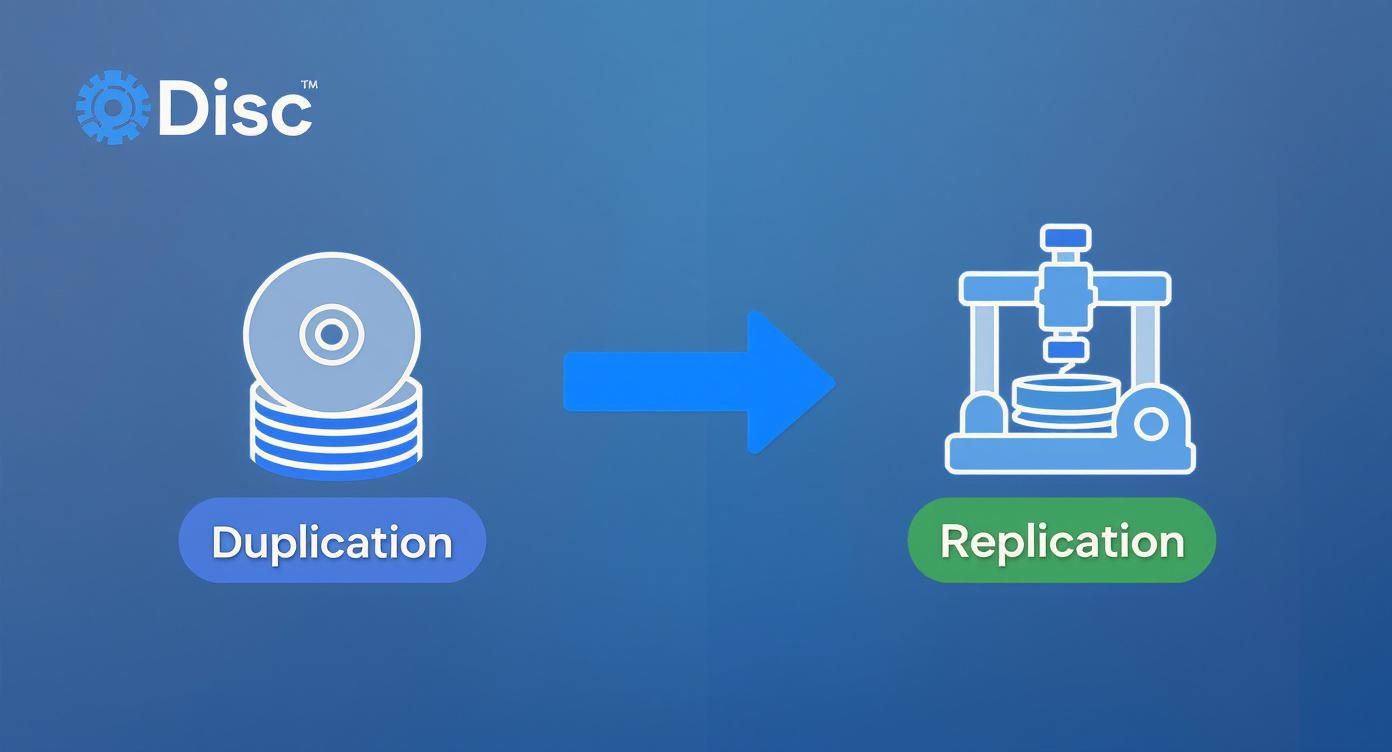
As you can see, duplication is a direct burn from your master, while replication involves creating a glass master to physically press the data onto the discs.
Finally, your freshly printed and burned discs are carefully assembled into the packaging you chose. This is the moment your project really comes to life, whether it’s sliding into a classic jewel case or being slipped into a simple, budget-friendly paper sleeve.
Before they start burning the whole batch, always ask for a proof. Getting a digital or physical proof of the printed artwork is your final opportunity to catch a typo or a design flaw. Any good service offering CD duplication near me will happily provide one.
Why People Still Duplicate CDs Today
In a world that runs on streaming and downloads, it’s easy to write off the good old CD as a relic. But for a surprising number of creators, professionals, and organizations, physical media isn’t just surviving—it’s thriving. The search for “CD duplication near me” is often driven by the simple fact that a tangible product offers something a digital file can’t.
Think about an indie band playing a local gig. After pouring their hearts out on stage, they can sell a fan a professionally printed CD. That’s a real, personal connection. It’s not just a link in an email; it’s a piece of their art that someone can hold, look at, and own. It turns a casual listener into a true supporter, funding their next project directly.
Or what about a photographer delivering a wedding album? Handing over a custom-branded CD with high-resolution images feels far more premium and secure than a simple download link. It adds a touch of class and reinforces the quality of their work.
Niche Markets and Professional Needs
Beyond the creative arts, CDs are still mission-critical in a bunch of professional and archival fields. Many software companies, for example, still ship installation discs. This guarantees a stable, offline setup for their clients without relying on spotty internet connections or server uptime. It just works.
The demand for physical media is surprisingly resilient. This is reflected in the steady growth of the global CD/DVD Blu-ray duplicating machine market, which was valued at USD 150 million in 2024.
And it’s not slowing down. That same market is expected to climb to USD 181 million by 2031. This growth isn’t just from musicians; it’s fueled by a constant need for reliable, long-term storage in sectors like government, military, and legal document preservation. The U.S. continues to be a huge part of this market, showing just how relevant physical discs remain in institutional settings. If you want to dive deeper into the numbers, you can find more insights about this growing market on intelmarketresearch.com.
For these specific needs, nothing beats the speed, security, and professional feel of a physical CD. It’s proof that sometimes, the old ways are still the best ways.
What to Expect: Pricing, Turnaround, and Customization
Getting a clear and accurate quote for your project really comes down to three things. When you’re looking for “CD duplication near me,” the final price tag almost always boils down to how many discs you need, how fast you need them, and how you want them to look.
Each one of these factors can make a big difference in the total cost of your order, so let’s break them down.
More Discs Usually Mean a Lower Price Per Disc
Most local duplication services work on a tiered pricing model. It’s simple: the more you order, the less you end up paying for each individual disc.
Think of it like this: a small, one-off run of 25 CDs might cost you a few dollars apiece. But if you bump that order up to 250, the price per unit could easily drop below a dollar. This bulk-discount approach is standard practice in the industry. You can get a good idea of how quantity affects your budget by checking out different bulk CD duplication options.

To give you a clearer picture, here’s a table that breaks down some common pricing and turnaround scenarios you might find with a local duplication service.
Local CD Duplication Pricing and Turnaround
A comparison of common service packages to help you estimate costs and timelines for your CD duplication project.
| Service Package | Average Cost Per Disc | Typical Turnaround | Best For |
|---|---|---|---|
| Small Batch (25-50 discs) | $2.00 – $4.00 | 2-3 business days | Demos, small promo runs, personal mixtapes |
| Standard Run (100-300 discs) | $0.90 – $1.50 | 3-5 business days | Album releases for local bands, corporate training |
| Bulk Order (500+ discs) | $0.60 – $1.00 | 5-7 business days | Major promotional events, widespread distribution |
| Rush Order (Any quantity) | Varies (adds 25-50% to cost) | 24-48 hours | Last-minute needs for shows or deadlines |
Remember, these are just ballpark figures. Your final cost will always depend on the specific customization and packaging you choose.
Balancing Speed and Cost
Turnaround time is the next big variable. Standard service is always the most wallet-friendly option, with most local shops able to get small-to-medium orders done within 3-5 business days.
But what if you have a show this weekend and just ran out of merch? No problem. Most providers offer rush services for an extra fee, and it’s often possible to get your order completed in as little as 24 hours.
It’s easy to think physical media is on its way out, but specialized local duplication is still a vital service for many. The recordable media manufacturing sector in the U.S. is actually projected to hit $1.5 billion in 2025, thanks to niche markets that still depend on physical copies. If you’re curious, you can learn more about the current state of the media manufacturing industry on ibisworld.com.
This steady demand means local experts are ready and waiting to handle those quick turnarounds for artists and businesses who really need them.
Making It Look Good: Customization and Printing
Finally, let’s talk about the look and feel of your CD. The visual appeal plays a huge role in the final cost, and your choice of on-disc printing and packaging is what gives your project that professional, finished touch.
Here are the most common printing methods you’ll run into:
- Inkjet Printing: This is your go-to for cost-effective, full-color photographic images, especially on smaller runs.
- Thermal Printing: This method uses heat to apply a super durable, smudge-proof image. It’s perfect for bold text and graphics and gives off a very slick, professional vibe.
- Screen Printing: The best choice for large orders with simpler, solid-color designs. It produces vibrant, long-lasting results but does come with higher initial setup costs.
Each printing style has its own strengths. The best way to decide is to chat with your provider about your artwork. They can help you pick the perfect option that fits both your budget and your creative vision. Once you have a handle on these three pillars—quantity, speed, and design—you’ll be able to ask for a quote with confidence, knowing exactly what you need.
Your Final Checklist Before Placing an Order
You’ve done the hard work of picking a duplication service and you’re just about ready to pull the trigger on your order. Hold on. Before you hit that “submit” button, let’s run through one last check to make sure everything goes off without a hitch.
A few minutes now can save you a world of headaches later.
First things first, let’s talk about your master files. Whether it’s audio tracks for a mixtape or data for a presentation, you need to be absolutely sure everything is in the right format and in the correct sequence. One little glitch here can throw a wrench in the whole operation.
Next up is your artwork. Double-check that your designs match the duplicator’s specs for dimensions, color profiles, and resolution. This is crucial. Always, always ask for a digital proof and look it over with a fine-tooth comb. Catching a typo or a design flaw at this stage is a lifesaver.
Finalizing Your Order Details
With your files prepped and ready, the last piece of the puzzle is locking in the logistics. This is where you iron out the final details to avoid any last-minute surprises.
- Final Quantity and Packaging: Be crystal clear on the exact number of discs you need and the packaging you’ve chosen. A quick glance at how different packaging options look can confirm it matches your vision.
- Turnaround Time: Reconfirm the completion date. This is especially important if you’ve paid extra for a rush job.
- Delivery or Pickup: How are you getting your finished CDs? If you went with a local company for CD duplication near me, make sure you coordinate a pickup time.

Taking a moment for this final review is the best way to guarantee your project turns out exactly how you envisioned it—on time and looking sharp.
Got Questions? We’ve Got Answers.
Even when you have a solid plan, a few last-minute questions always seem to pop up when you’re searching for “CD duplication near me.” It’s totally normal. Getting those nagging questions answered is the final step to moving forward with confidence.
Here are a few of the most common things we get asked by musicians, artists, and businesses just like you.
Duplication vs. Replication: What’s the Real Difference?
This is easily the number one question we hear, and it’s a great one. The simplest way to think about it is this: duplication is like burning a CD, just on a much faster, professional scale. It’s perfect for smaller runs—anything under 500 copies—and it’s incredibly fast.
Replication, on the other hand, is the full-on factory process. A “glass master” is created and used to physically press your data onto thousands of discs. It’s the most cost-effective route for huge orders, but it naturally takes a bit longer.
How Do I Need to Prep My Files?
Getting your files right from the start saves everyone a headache. For audio projects, most pros prefer a physical master CD or a DDP (Disc Description Protocol) image. This locks in your track order, spacing, and all that good stuff perfectly.
For a data CD, a simple ISO file usually does the trick. When it comes to your artwork, you’ll want high-resolution files (think PDFs or JPGs) built on the template your provider gives you. This is the key to getting that crisp, professional look instead of a blurry mess.
Take a minute to double-check your provider’s specific file requirements before you send anything over. A quick call or email can literally save you days of delays and make sure your project turns out exactly the way you’re picturing it.
Can I See a Proof Before You Make All of Them?
Absolutely, and you should always ask for one. Any reputable service will offer a proof of your printed materials, either as a digital file or a physical sample.
It might add a day or so to your timeline, but approving a proof is the single best way to catch any typos or design mistakes before you’re stuck with hundreds of copies.
Ready to make a one-of-a-kind mixtape for someone special or get a professional run of your latest album out into the world? Mixtape Duplication is all about fast, high-quality CD duplication with a personal touch. Start your custom CD order today!
About the Author: CDinser
